Finding My Feet by West Lake
Repaying a kindness, discovering the lake and learning enough Chinese to buy my favourite things.
With only about three hundred yuan readily available, I went to the bank with YoYo. I wanted to find out how to access the money in my British account and, above all, repay Andy for the eight thousand yuan he had lent me while I was arranging my apartment.
I had money in Britain. I just hadn’t worked out how to make it useful here.
Then Andy told me we had been paid. I could also submit my expenses from the UK, including the visa fees and train tickets.
It had only just dawned on me that the time I had spent training was paid work too. Finding four thousand yuan in my Chinese account was a considerable relief.
Together with six thousand yuan from my British account, I now had enough to repay Andy in full and keep two thousand to get me through to the next payday.
With that worry eased, I began exploring the place I had chosen to live.
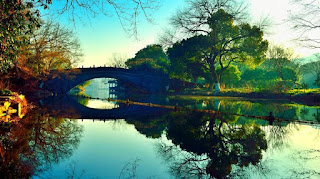
On a day off during my first weekend in the apartment, I set out for West Lake. There were crowds of visitors, boats on the water and hills rising beyond it. People sometimes asked for photographs with me; occasionally, someone wanted me to hold their baby for a picture. I could only guess at the reasons for their curiosity.
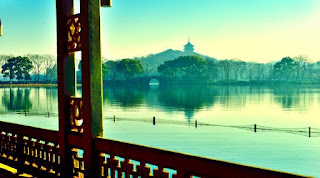
I used a large Starbucks as one of my first landmarks. Around it were gift shops, ice-cream stalls and places to eat. Further along, I passed restaurants serving noodles and rice, including rice presented inside a pineapple, as well as shops selling tea, fans, silk scarves and carved stamps.
There was something to stop and look at almost everywhere.
The paths took me through gardens and patches of dense greenery, with places to sit and watch the water. Groups of women danced together to music, drawing small audiences as they moved in time.
Elsewhere, people used large brushes dipped in water to write Chinese characters on the paving stones.
At first, I couldn’t see the point of making something that would disappear so quickly. Yet I found myself watching. I couldn’t read the words, but the movement of the brush and the shapes it left behind were beautiful.
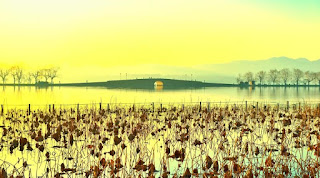
This was part of what I had wanted from China: ordinary public spaces full of things I didn’t yet understand. I could spend an afternoon looking, listening and finding another question to ask.
Food was still one of those questions. Lawson became a useful place to find answers.
The convenience stores were like small supermarkets, although much of what they sold was unfamiliar. There were sweet buns, bread topped with meat floss, packaged rice meals and counters of hot snacks.
At first, I gravitated towards the things I recognised: sandwiches, wraps and salads. It was reassuring to know what I was buying.
Gradually, I became braver. Ready meals could be heated at the counter, and I learned the phrase jiā rè—加热—to ask for that. A meal came back warm, with chopsticks, and another small problem was solved.
The steamed buns were less easy to identify. Without being able to read the labels, I couldn’t tell what was inside. Pictures helped. So did one particularly useful phrase: wǒ yào zhège—我要这个—‘I want this.’
I pointed, tried something and remembered the ones I liked.
The pork buns became such a favourite that I sometimes bought several and ate them throughout the day. Breakfast, lunch, dinner or a snack: I wasn’t particularly strict about the category.
YoYo had introduced me to tea eggs. When I told her I liked them, she taught me their name: cháyèdàn—茶叶蛋. Soon I was buying them regularly, usually for around two yuan each.
Other foods took more getting used to. The sausages were sweeter than I expected. At the counter, compartments of broth held skewers of different shapes, along with seaweed and mushrooms. I often saw colleagues return to work with generous selections, while I was still trying to identify everything.
There were familiar comforts too: ice cream, biscuits, dried fruit and coffee. One coffee-and-milk-tea drink tasted to me rather like melted custard. At around eight yuan, it became a favourite—and, for a while, a twice-daily habit.
My progress was hardly dramatic. I could repay a debt, find my way to the lake and ask for a bun I knew I liked.
But those small things were becoming a life.